Showing posts with label autism. Show all posts

Thursday, April 21, 2011

April is OT Month and Autism Awareness Month!


Another apology is in order for the neglect of my blog. I’ve had several blog entries “in the works” for a long time, but have failed to finish developing them and getting them up here. I’ve made a promise to myself to get back into this, and my goal is to try to publish at least once a week! So if you’ve abandoned my blog because I haven’t updated in a long time, please come back!!! It seemed appropriate to come out of hibernation to blog during April, as April is the celebration of both Occupational Therapy, and Autism Awareness! I work with, and have worked with, many children and adolescents on the autism spectrum (about 1/3 of my current caseload has a diagnosis on the spectrum), so Autism Awareness is something that is important to me. In honor of both April celebrations, here is a general overview of autism and how occupational therapists work with individuals on the autism spectrum.


First, for those unfamiliar with autism, allow me to explain what I mean by “autism spectrum.”  This is an umbrella term that refers to a group of developmental disabilities that may cause significant challenges in the areas of social skills, communication, sensory processing and behavior.  The general term Autism Spectrum Disorder (ASD) [which can also be referred to as Pervasive Developmental Disorder (PDD)], refers to the following three disorders: Autistic Disorder (also called “classic autism” or just “autism”), Asperger’s Syndrome, and Pervasive Developmental Disorder Not Otherwise Specified (PDD-NOS).

Someone diagnosed with Autistic Disorder generally has significant language delays, social and communication challenges, [unusual]* and/or stereotypic behaviors and interests, and atypical processing of sensory experiences. Often people with autism also have intellectual disability, but low IQ is not a diagnostic criteria. Within the classification of Autistic Disorder, there is variation in severity and functionality, though there is no “official” distinction, many people will often refer to different levels in terms such as “high functioning autism” or “severe autism.” Asperger’s Syndrome shares some symptoms with Autistic Disorder, such as social challenges and [unusual]* behaviors or interests, but symptoms exist in a more mild form, and there is no language delay. Typically those with Asperger’s Syndrome do not have intellectual disability and generally have average to above average intelligence. A diagnosis of PDD-NOS is given when an individual meets some criteria for Autistic Disorder but not all criteria. Signs of ASD in young children may include lack of, or delay in, spoken language; repetitive use of language and/or motor movements (example: echoing or scripting what another says instead of speaking spontaneously, hand-flapping , or twirling objects); little or no eye contact; lack of interest in peer relationships; lack of make-believe play; and persistent fixation on parts of objects.
*Author’s note: I bracketed [unusual] because these words are included in literature about diagnostic criteria for autism, however, I do not like these words. I do not feel as a “neurotypical” (the term that people on the autistic spectrum often use to describe those who are not) that I have the right to pass judgment on behaviors and interests of those on the spectrum, or anyone for that matter. To the person, it not unusual, so what right do I have to say it is?! Also, in my opinion often these interests aren't even necessarily so "unusual," often people with ASD just have very specific interests that can be quite intense (often referred to as obsessions or perseverations), such as Jason and his interest in the subway. Also, interests may seem "unusual" because people with ASD are often very detail oriented. The way one little girl I treat "plays" with toys is to line them up in various categories, such as organizing them by color, size and shape. To her, this is more interesting than using toys for their intended purpose. I suppose this may seem "unusual" but for her lining toys up into organized categories is meaningful and makes sense to her. It is the propensity for specific, intense, and often detail-oriented interests that can allow people with ASD to make important contributions to society. Temple Grandin (a woman with autism well-known for her work both in the autism community and her accomplishments in the field of animal husbandry), jokes that NASA is the largest sheltered workshop in the world! We should be thankful for these "unusual" interests!
autism
What do occupational therapists do to treat individuals with ASD?  As discussed in previous blog entries, OTs assist when a person is experiencing barriers to successful participation in his or her daily occupations. OTs will work with clients diagnosed with ASD in many different areas of occupation. Interventions may target regulating emotion and behavior; processing sensory information that is needed for participation in occupation; developing social abilities, interpersonal skills and peer relationships; self-care skills such as dressing, feeding, hygiene, and sleep; skills for school success such as organization of task materials, independent work skills, group process abilities; using assistive technology to accomplish communication or other occupational needs; and developing motor skills that may be delayed.

I mentioned in previous blog entries that in December I attended the 2010 American Occupational Therapy Association (AOTA) Autism Specialty Conference in Baltimore, MD, which was an amazing opportunity to hear from the experts in the field, as well as convene with other occupational therapists who treat clients on the autism spectrum. At the conference, a point that was emphasized throughout the two days of presentations was that people with ASD are people first and a diagnosis second. They may have difficulty expressing and understanding feelings, but they certainly have them. Just because they lack social awareness and social skills does not mean they don’t long to be included. Research shows that children and adults on the autism spectrum want to have meaningful relationships, they just don’t know how. Additionally, people with ASD can contribute wonderful things to society. Sometimes, however, they just need to make their own way.  The norms of a society that is mainly made up of “neurotypicals” may not be how individuals with ASD find their path to success, and that is okay! As OTs, we have the ability to help individuals carve their own paths in the world and be able to make unique and important societal contributions. Occupational therapists are equipped with the skill set to look at a person’s strengths as well as challenges, analyze the tasks the person wants or needs to do, take into account the environment and extraneous factors that may support or inhibit participation, and collaborate with the individual to find a unique solution that allows for success!

At the conference, I had the privilege to attend presentations given by adults on the spectrum, and something they taught me that really made an impact on me was that many people with ASD do NOT consider themselves to have a disability!! They just accept that they are “wired differently” from neurotypicals. Most of these individuals have no desire to be neurotypical. They do not need to be “fixed.” They just want to be accepted, and assisted in order to be successful functioning in neurotypical society. Many adults on the spectrum have found the ability to celebrate their uniqueness and accept and embrace autism as a diversity. Now, if only neurotypicals would see it that way!


Sources for this blog entry include presentations from the 2010 AOTA Autism Specialty Conference, and “The American Occupational Therapy Association Frequently Asked Questions: What is Occupational Therapy’s Role in Supporting Persons With an Autism Spectrum Disorder?”

Tuesday, December 21, 2010

"Seven senses? Like that movie with Bruce Willis where the kid can see dead people?" Sensory Processing and our Seven Senses


I’ve mentioned sensory processing (also known as sensory integration) a few times in my past blog entries. Non-OT readers of this blog have probably been wondering exactly what I’m talking about. It’s a part of my everyday language as a pediatric OT, and it’s actually part of every single person’s everyday neurological process, but outside my field it’s not something commonly known about or talked about. So here’s my “sensory processing in a nutshell” explanation.

Those not familiar with the term “sensory processing” may be able to deduce that it has something to do with how the brain processes information from one’s senses. However, what you may not know is that people actually have SEVEN senses that we receive input from. (And no, the sixth sense is not being able to see dead people!) There are the 5 “basic” senses that most people are familiar with: touch (tactile sense), sound (auditory sense), sight (visual sense), smell (olfactory sense) and taste (gustatory sense). However, there are also two other systems from which receive input and contribute to sensory processing: the vestibular system (movement sense) and the proprioceptive system (position sense).

The first "secret sense" that is very much a part of your sensory system but few people are aware of is your movement sense. The vestibular system. Vestibular receptors are structures within the inner ear. When the head changes position, these structures register this information and send it to the brain to process it to help determine the body’s position in relation to earth’s gravity. This system is how people know when they are in motion.
The OT in this picture is providing vestibular input to a child on a therapy swing
Proprioception, "the position sense" is the brain’s unconscious ability to determine where all one’s body parts are without having to look at them, and where the body is in relation to other objects or people without having to touch them. Receptors in our muscles, joints, and connective tissue (ligaments and tendons) receive propioceptive input and send it to the brain to process. It is how the brain interprets sensory messages about the position, force, and direction of one's body and its parts. Gravity acts on these receptions even when we are not moving.

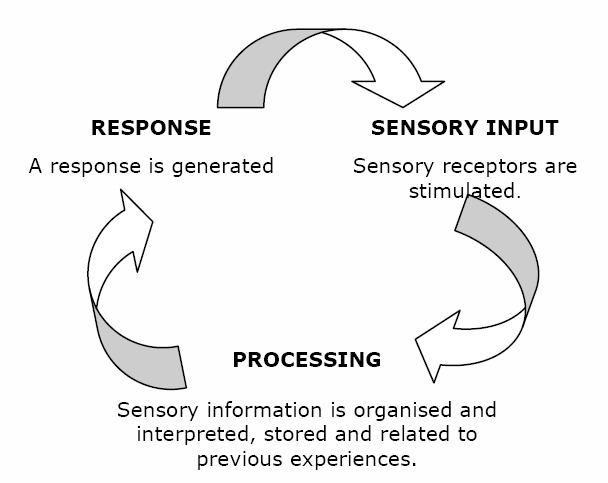
Sensory integration/processing is a normal neurological process that every person’s neurological system does, all the time. Every person’s nervous system/brain is designed to receive information from the world around us through sights, sounds, touch, tastes, smells, movement and gravity. The body receives this input, and the brain perceives and interprets the information. The brain then “tells” the body what to do based on how it is interpreting the sensory information. When people experience a challenging level of sensory simulation and successfully respond to it, they develop an “adaptive response.”
Sensory processing problems occur when some aspect of sensory processing does not function effectively, and the person may experience stress throughout the course of everyday occupations. This is because the neurological processes should be automatic and accurate (the processes of taking in sensory input, interpreting it, and generating an appropriate adaptive response) are not.

Even with properly functioning sensory processing, everyone has sensory preferences and dislikes. For example, loving or hating rollercoasters, spicy foods, certain musical dynamics, scents or colors. That is normal. However, for children who have sensory processing disorder/sensory integration dysfunction, or “sensory issues,” the way they experience the world is so much more than sensory preferences or dislikes.

When there is a breakdown in these neurological processes, it can manifest in several different ways (and every child is different!) It can present as a trouble with sensory modulation, which causes the child’s responses to sensory input to be out of proportion to the actual experience. This can present as over-, or under-responding to sensory stimuli, seeking sensory stimulation, or a mix depending on the type of input and the situation. Another effect of sensory processing difficulties can be motor output that is disorganized as a result of incorrect processing of sensory information. The child may be dyspraxic (unable to plan and execute motor movements necessary for everyday tasks), and appear accident-prone, clumsy, physically awkward and struggle with both gross and fine motor skills.  Another manifestation can be difficulty perceiving the salient qualities of sensory input, and/or struggling to differentiate between sources of sensory stimuli, such as judging how much force to use on different objects. However, the most common manifestation is disordered modulation and the seeking or avoiding of types of sensory input due to the inability to effectively process that input.


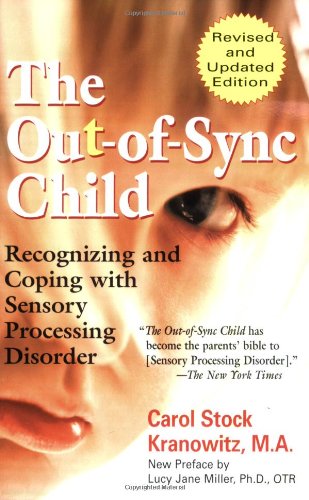
Sensory Processing Disorder (SPD) will be recognized for the first time in the upcoming DSM-V (the Diagnostic and Statistical Manual of Mental Disorders). SPD is becoming more widely recognized in the pediatric community, with many books shedding light on this issue hitting the shelves for both professionals and as self-help for parents of children experiencing these problems. These books include “The Out of Sync Child” and “The Out of Sync Child Has Fun” both by Carol Stock Kranowitz, “Raising a Sensory Smart Child” by Lindsey Biel and Nancy Peske, and “Sensational Kids” by Lucy Jane Miller and Doris A. Fuller. These are all books I’ve read, loved, and recommended to parents, and parents have reported back to me about finding hope and understanding in these books.

In addition to children with SPD, most  children diagnosed on the autism spectrum also have significant sensory processing problems. In a study of children with autism spectrum disorders, 94% of the 200 children studied having significant sensory issues*. In the mental health realm, sensory processing issues are inherent to schizophrenia. A number of other disabilities include problems with sensory processing and/or are co-morbid with sensory processing disorder.

So what do occupational therapists have to do with sensory processing? OTs deal with sensory processing because when a child has issues with sensory processing, it affects his or her ability to play, work, learn, have appropriate social interactions, dress, eat, and function within their family or school environment. Anything affecting a child’s ability to engage in his or her childhood occupations (self-help, eating, functioning in his or her family unit, and functioning in school) OTs can be involved. Now you may be wondering what is it that OTs do for these “sensory kids”? OTs use the Sensory Integration Frame of Reference (affectionately known as SI) developed by A. Jean Ayres to guide treatment. First, when beginning treatment, OTs meet the child where he or she is at. Therapists provide the child with opportunities to get a lot of the input he or she is seeking while monitoring it to help the child stay regulated, and do not force input that he or she is defensive of. Therapists help the child feel safe, calm, and comfortable in his or her own body and in the environment. We as pediatric OTs create an environment that facilitates exploration of different sensory experiences that is both fun for the child and therapeutic. OTs use a variety of swings and suspended equipment, textures, fabrics, toys, games, places to crash, things to climb, music, and other equipment to create a sensory environment that is both comfortable and challenging for each child. We use knowledge of sensory processing and how the brain perceives the different types of sensory input to create experiences that will affect his or her brain’s ability to process and regulate sensory information and generate adaptive responses.

Not the gym I work in but a very good example of the equipment used in an OT "sensory clinic" much like where I work

Hope that clarifies a bit. Not wanting to make this entry too long, I will save specific examples of sensory processing disorder with the kids I treat for a later blog :)

*(Greenspan & Wieder, 2000)

Thursday, December 09, 2010

A lesson learned about assumptions

In my job, I work primarily in a private pediatric therapy practice with pre-school and school aged children in New York City in a clinic setting. Through the practice, I also contract to a secondary school and work with middle and high school aged children in the public school system two mornings per week. At this school, I treat a high school student who has “high functioning” autism. I will refer to this student Jason (not his real name). Jason is fascinated by the New York City public transportation system, particularly the subway system. In fact, the very first thing Jason said to me during our first occupational therapy session, after “hello” was, “Did you read the Subway Report Card that was published?” Then he proceeded to give me abundant detail about the best and worst lines and why each line ranked the way it did. He is forever giving me random subway statistics, such as which line is longest and which is shortest, or how many lines cross more than two boroughs. It is not uncommon for individuals with autism to fixate on a certain interest and develop an extensive knowledge base on this interest. It is also common for these individuals, who frequently have trouble understanding social cues and social protocol, to have difficulty understanding that others do not always share these the same interests, and may not be as excited to hear all about [subways, space, animals, ect].

With many of my teenagers at this school, I work on community mobility goals, especially with the students that are in the “basic” program (a program in which they do not receive a high school diploma from but an IEP diploma instead, the program focuses on life skills and functional skills as opposed to just academic skills). With many of my students who have these goals, we look at subway maps and talk about how to read them, and plan routes from point A to point B. This is not one of Jason's goals, but Jason always requests to look at subway maps in OT sessions. However, he has more knowledge about the subway system than most MTA workers probably do! He loves inventing “challenge problems” and will walk into sessions and ask things such as, “So today can we look at the subway map and can we try to figure out how to get from point A in Brooklyn to point B in the Bronx and pretend it’s a weekend, so line X runs a modified route and line Y doesn’t run, and there’s a snow storm and all elevated lines are not running?” Since looking at the subway map brings him so much joy, but is not therapeutic to address since it is a skill he already excels at, I came up with an idea. In therapy, I have been having Jason write down subway problems and answer keys for other students with whom I am working on community mobility with to figure out. This helps him work on his organizational skills, and the legibility of his handwriting, which are goals of his. This also helps him with social skills, because it is very hard for him to understand that not everyone understands the subway system as well as he does. I do let him write some “super duper challenge questions” that he really enjoys to figure out, but then I try to help him understand how to simplify things and create “beginner” questions that his peers may actually be able to do. Bingo! He gets to look at subway maps in OT, but I have made the exercise more functional for the skills he needs to work on. He feels so honored to have taken on this responsibility of creating subway problems for the kids I work on community mobility goals with. He loves to hear how the other kids are doing with the problems and continuing to create new ones. Jason has become my resident community mobility expert at the school.

After working with Jason twice per week for the last 2 months, one thing he told me served as a huge eye opener for me as a young therapist. For a young man who loves the subway system so much, and is so adept at theoretically navigating the subways, I incorrectly assumed that Jason was independent in community mobility, therefore it did not need to be an OT goal of his. Then, one day, I do not even remember exactly what we were talking about (as many of the conversations we try to have somehow end up relating back to the subway system), but he ended up mentioning something that shocked me. He told me that he cannot ride the subways by himself, and does not actually go anywhere in New York City on the subway without his mother! He revealed that the crowds on the subway and all the loud noises bother him too much and make him anxious, and he is afraid to go anywhere alone without his mother for this reason. A high functioning, bright teenager who is an expert on the subways, cannot ride the subway independently! Out of all my students at the school, I expected Jason to be the one who is most independent in community mobility because of his extensive subway knowledge and uncanny ability to quickly figure out how to travel between two points in New York City during any time of day or any unplanned circumstance. I felt so silly for assuming this, because I am aware that as OTs, we are taught to be masters of holistic thinking and task analysis. We learned in grad school how to think of all factors that are involved with everything our clients need to do on a daily basis. However, it just didn’t occur to me to ask him if he has any difficulty with community mobility because Jason spends so much time talking about it and demonstrating theoretical competence with it.

**Lightbulb moment!** There are a lot of generalizations here, but individuals with autism tend to have very strong visual/visual perceptual skills. Which is why PECS (a picture exchange communication system for kids with autism who have limited or no verbal abilities), picture schedules, pictures of each step of tasks, and pictorial social stories are so successful with individuals with autism. Also, individuals with autism tend to think very concretely and logically. So, it is not surprising that reading a subway map and quickly being able to determine even difficult routes is a breeze for Jason. Riding a subway is completely different! The sensory challenges of riding on a subway are monumental. (Why didn’t I originally consider this?? I spend most of my professional life addressing sensory challenges with the little kids at the clinic!) People with autism are frequently very auditorily defensive, meaning their brains process sound differently from people with typical neurology. Their brains have difficulty processing and interpreting auditory input, and as a result often everyday sounds that are noxious to most people can be overwhelming and even painful for those with autism. Additionally, people with autism often have difficulty processing input from other senses, such as the sense of movement (vestibular) and the sense of touch (tactile), and have a lot of sensory sensitivities. This is the case for Jason. Being on a subway is a very intense sensory experience for even people with typical neurology. The subway car starts and stops frequently, and dives underground and rises above ground quickly, in addition to sometimes making quick turns. The track can be bumpy. The car can sometimes vibrate and shake. There is gratuitous noise. The wheels screech. The doors ding. The conductor makes announcements. A booming computerized voice is constantly updating the passengers about the next stop, the current stop, to be mindful of the closing doors, to keep an eye on belongings. People talk to each other at loud volumes. On a crowded subway car you will be brushed against by many different people and their different textured coats and bags. For someone with autism who may have sensory processing difficulties and sensitivity to some sensory input such as auditory, vestibular and tactile input, it can be overwhelming and even traumatizing! No wonder Jason, despite his subway knowledge and navigational skills, cannot bring himself to ride the subway alone without the comfort of his mother!


This to me was a reminder about to never assume things, and to always consider all aspects of a task. Considering the environment, all skills required both cognitive and physical, and body systems required including sensory processing, is just as important as the actual steps of the task being performed. This goes down to the very core of what occupational therapy is, and we as OTs learned that in OT school ad nauseum. I learned that I should not have assumed independence in community mobility for Jason just because he is an expert in theoretically navigating the public transit system. There are so many more demands intrinsic to the task of riding the subway and factors that are part of Jason's neurological processes that are limiting Jason’s ability to be successful in this task. All these aspects need to be addressed that I originally did not fully consider. As OTs, we need to constantly remember, that more than any other person our clients work with, we are equipped with the skills to analyze all areas of every single task and occupation. Even though the goals on paper may say “will be able to determine the route between two points in New York City using the subway map to improve independence in community mobility skills,” there is so much more to riding a subway than that, and we are responsible for helping out clients find the tools to be successful and not just addressing the goals at face value.